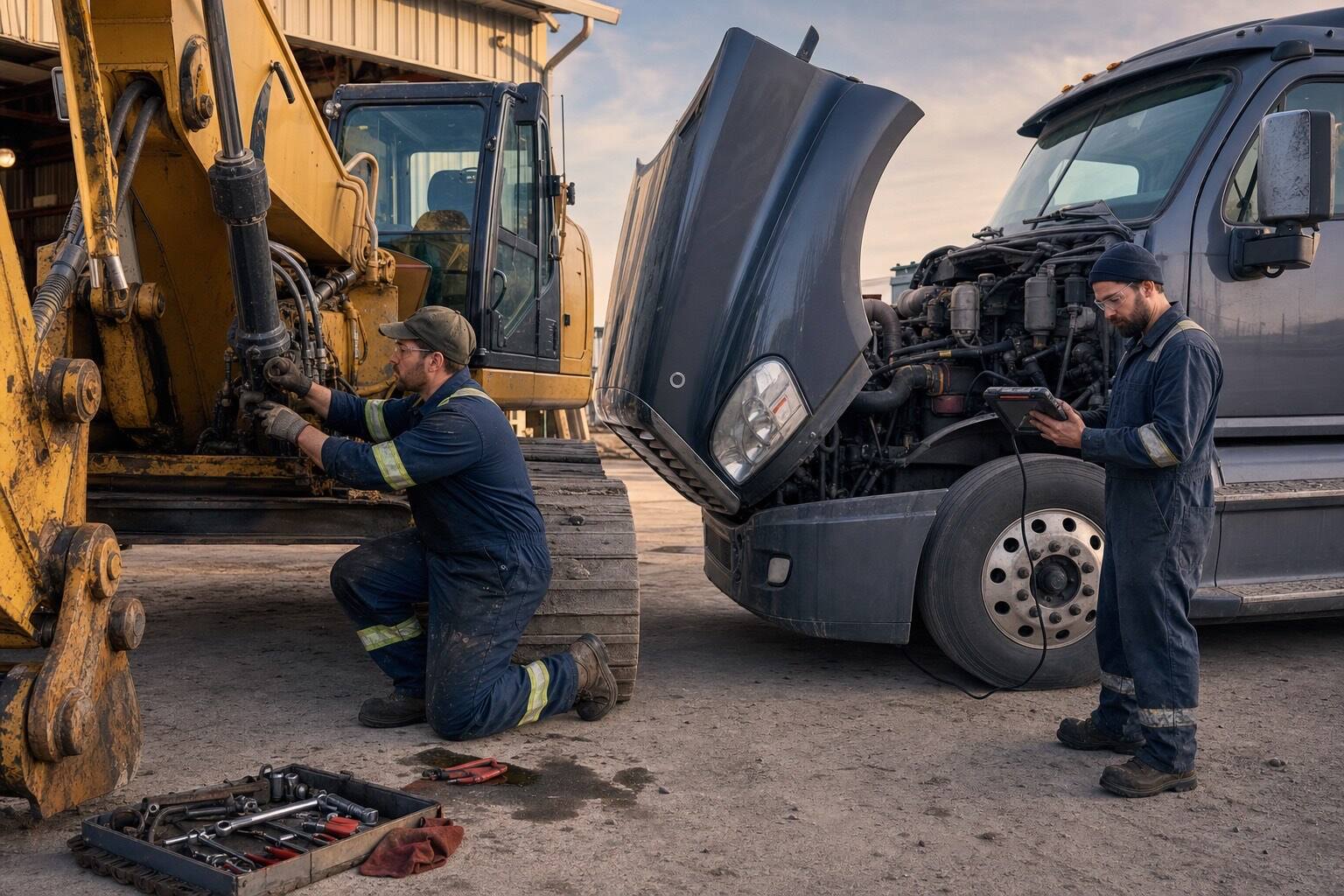
Suppose you have two job leads. One is at a truck fleet. The other is with a heavy equipment dealer. Both want diesel experience, both promise training, and the hourly rates are close.
The job titles won't tell you which one you'll like more.
Here is the more useful question: Would you rather track down an air leak before a tractor leaves on its route, or figure out why an excavator's boom gets slow once the hydraulic oil is hot?
Both jobs involve engines, electrical systems, service information, dirty parts, and expensive equipment that somebody needs back. What changes is the equipment around the engine, the problems you'll solve most often, and where you'll be standing when you solve them.
Neither side is automatically better or more advanced. You are choosing a group of problems and a working life, not picking the winning side of the diesel trade.
The short answer
Truck diesel work may fit you better if air brakes, steering, suspension, trailers, aftertreatment, and road safety interest you. Many of these jobs are based in a fleet or dealership shop. The work often follows inspection schedules and a steady flow of vehicles that need to get back on the road.
Heavy equipment work may fit you better if hydraulics, machine controls, undercarriages, attachments, and powertrain systems grab your attention. These jobs can put you in a shop, a service truck, or the middle of a jobsite with a machine that won't move.
If both sound good, that isn't a problem. A well-run employer with patient trainers, safe equipment, current service information, and a clear raise path is usually a better first move than chasing the perfect title.
What the work feels like
A list of systems helps, but it doesn't show you how the day moves. Picture the kinds of complaints that arrive in each shop.
A day in a truck shop
You might start with a preventive maintenance inspection on a highway tractor. While it is in the bay, you find brake wear that needs attention. The next work order is an intermittent ABS light on a trailer. After lunch, a driver reports that another truck won't complete a regeneration.
The pressure usually comes from uptime and safety. A fleet needs the vehicle for tonight's route, but you still have to inspect it properly, prove the fault, document the repair, and decide whether it is safe to release.
Truck technicians commonly work on:
- air and hydraulic brakes;
- steering, suspension, tires, and wheel ends;
- starting, charging, lighting, wiring, and vehicle networks;
- engines, cooling systems, fuel systems, and aftertreatment;
- clutches, transmissions, drivelines, and differentials;
- trailers, liftgates, doors, and related electrical or hydraulic systems; and
- preventive maintenance inspections and road tests.
The O*NET profile for bus and truck mechanics includes brake and steering inspections, electrical and emissions repairs, diagnostic equipment, and testing vehicles after repair. The common thread is that the truck must do more than run. It has to return to public roads safely.
The employer changes the rhythm. At a fleet with hundreds of similar vehicles, you'll see the same models and failure patterns often. That can help you get fast and thorough. At a dealership or independent shop, you'll usually see more brands, customer complaints, and warranty procedures.
A day around heavy equipment
Your first job might be measuring track wear on a dozer. Then a loader arrives with a steering problem. Later, you take a service truck to an excavator that moves normally when cold but loses digging power after an hour.
Now the pressure comes from a machine holding up a crew. You may need to reproduce the problem under load, read a hydraulic schematic, take pressure or flow readings, and work out whether the fault is in a pump, valve, cylinder, electrical control, or something else entirely.
Heavy equipment mechanics commonly work on:
- hydraulic pumps, motors, valves, cylinders, hoses, and controls;
- engines, fuel systems, cooling systems, and aftertreatment;
- wiring, sensors, electronic controls, and machine networks;
- transmissions, axles, final drives, and differentials;
- tracks, rollers, idlers, sprockets, and other wear parts;
- booms, buckets, blades, and other attachments; and
- machine calibration, operational checks, and field repairs.
The O*NET profile for mobile heavy equipment mechanics includes hydraulic, pneumatic, electrical, and power-transmission work. It also covers reading schematics, inspecting machines while they operate, calibrating equipment, and repairing parts such as transmissions and crawler assemblies.
The key difference is machine function. A pressure reading means little until you understand what the boom, steering, travel, or implement circuit should be doing at that moment.
Why the titles overlap
Employers use “diesel mechanic” as a catch-all title. It can describe someone working on trucks, buses, construction machines, farm equipment, generators, or a mixed fleet. “Heavy-duty mechanic” can be just as broad.
The federal occupation profiles draw a clearer line. The Bureau of Labor Statistics profile for diesel service technicians focuses mainly on trucks, buses, and other diesel vehicles. Its heavy vehicle and mobile equipment profile covers construction, farming, rail, and other mobile equipment.
Real job postings don't always follow those definitions. Before you apply, find the equipment list and the daily duties. A posting titled “diesel technician” might be a truck job, a forklift job, or a field role working on generators and light towers.
The biggest technical differences
Both paths require mechanical judgment, electrical troubleshooting, safe lifting, and the ability to use service information. Both now involve laptops, fault codes, live data, wiring diagrams, and software. The split becomes clearer when you look at the systems you'll need to know in depth.
Truck work goes deeper into road systems
Truck roles put more weight on air brakes, wheel ends, steering, suspension, trailers, vehicle inspections, and roadworthiness. They can also involve a lot of aftertreatment diagnosis because duty cycle, maintenance history, wiring faults, sensors, and failed parts can all produce similar complaints.
Good truck work is not plugging in a scanner and replacing whatever part appears next to the code. You still have to test the circuit or system, prove the cause, make the repair, and verify that the original complaint is gone.
Heavy equipment work goes deeper into hydraulics and machine performance
Equipment roles usually demand more time with hydraulic schematics, pressure gauges, flow meters, contamination control, control valves, cylinders, and load-sensing systems. Undercarriage measurements, attachments, and machine calibrations may also become routine.
The complaint may sound vague: “weak when hot,” “drifts overnight,” or “slow only while lifting and traveling.” Solving it means understanding how several systems interact, not only checking one component.
The physical work is different too
Both jobs can be hard on your body. The difference is often the position and setting. A truck shop may mean plenty of overhead work, tires, brakes, creepers, pits, and time under a raised vehicle. Equipment work may put you on tracks, inside cramped compartments, around large attachments, or outside on uneven ground.
During a shop tour, look at how technicians lift components, block equipment, control stored hydraulic energy, handle exhaust heat, and keep people away from moving machines. Safety practices tell you a lot about the employer.
Shop work, road service, and field service
Don't assume all truck jobs are indoors or all equipment jobs are outside.
A truck fleet or dealership may keep most technicians in the shop, but mobile technicians handle breakdowns in yards, on roadsides, and at customer locations. An equipment dealer may have separate shop and field teams. A contractor or public works department may mix both into one job.
The BLS heavy equipment profile notes that field technicians may travel long distances, work outdoors, and complete repairs with limited direct supervision.
That last part matters. “Field service” can mean independence, variety, and a well-stocked service truck. It can also mean heat, cold, mud, long drives, limited parts, poor phone service, and a customer watching an idle crew lose time.
Before accepting a field job, ask:
- Is travel local, regional, or overnight?
- Does paid time begin at the shop, your home, or the customer site?
- What crane, welder, laptop, adapters, and common parts are on the truck?
- Who can help when the diagnosis stalls?
- What happens when the site isn't safe or the repair needs a shop?
- How often is the technician on call?
Those answers matter more than a photo of a clean service truck in a recruiting ad.
Schedules, overtime, and on-call work
Neither specialty owns the good schedule.
Some truck and bus shops operate around the clock. The BLS diesel technician profile notes that evening and weekend work is common in some shops, and some facilities provide 24-hour service. New technicians may land on second or third shift even when the company talks mostly about its daytime operation.
Equipment schedules often follow the customer and the season. Construction can bring early starts and urgent field calls. Agricultural shops can work long hours during planting and harvest. Rental shops may have steadier hours, but they still need machines turned around quickly and may provide field coverage.
Ask for numbers, not “some overtime.” Find out how many weekends the team worked in the last three months, how often the on-call phone comes around, and what a normal technician earned from call-outs. Also ask whether the posted shift is the shift you will have after training.
Tools and diagnostic software
You will probably need your own basic hand tools in either career. The expensive question is where the employee tool list ends and the employer's responsibility begins.
Truck shops may supply scan tools, vehicle interfaces, software subscriptions, lifts, brake equipment, wheel tools, and engine tooling. Equipment shops may supply hydraulic test equipment, lifting devices, machine interfaces, pressure gauges, flow meters, and field-service equipment.
Get the tool list before you accept the job. Ask which items you need on day one, which can wait, and whether the company pays a tool allowance. Make sure the shop has current service information and licensed diagnostic software for the brands it expects you to repair.
This can change the value of an offer. A higher hourly rate may not help much if you must immediately finance a large tool purchase. A slightly lower rate with supplied specialty tools, paid training, and regular raises may put you in a better position after a year.
Training and certifications
You can enter either path through a high school career program, diesel school, apprenticeship, military experience, a trainee job, or related automotive and industrial work. The guide to becoming a diesel mechanic explains how to compare those routes.
For truck technicians, the ASE Medium/Heavy Truck tests cover diesel engines, drivetrain, brakes, suspension and steering, electrical systems, heating and air conditioning, and preventive maintenance inspection. ASE can help show what you know, but it doesn't replace hands-on experience. Check whether the employers near you require it, pay more for it, or use their own training ladder.
A commercial driver's license may matter when a truck technician test-drives a vehicle on a public road. The Federal Motor Carrier Safety Administration explains that mechanics need the appropriate CDL when the vehicle is subject to CDL rules. Ask whether the employer requires it at hire, pays for training, and gives you time to earn it.
Equipment employers often care more about hydraulic knowledge and product training. Manufacturer programs can combine school with paid dealer experience. Caterpillar's ThinkBIG program, for example, combines an associate-degree program with dealership internships focused on equipment or power-generation service.
Don't collect certifications without a plan. Read local postings first. If the same requirement appears again and again at employers you would join, then it deserves your time and money.
Pay: compare the whole offer
Asking which specialty pays more sounds simple, but the answer changes by employer, location, shift, and type of work. A field equipment job with call-outs is not the same offer as a first-shift fleet job, even when the hourly rate is identical.
Compare these parts of the offer:
- guaranteed hours and base rate;
- shift differential;
- realistic overtime, not the busiest week anyone remembers;
- call-out minimums and on-call pay;
- whether travel time is paid;
- tool, boot, and uniform costs;
- health insurance and retirement costs;
- paid training and raises tied to completed training; and
- flat-rate, incentive, or productivity rules, if used.
Use the Diesel Mechanic Salary Guide for current national, state, and industry context. Then work out what each offer would pay in a normal month. Treat “unlimited overtime” as zero until the employer can tell you how many hours technicians usually get.
Which skills transfer between the two paths?
You can move from trucks to equipment or equipment to trucks. You won't be starting over, but you will have gaps.
These skills travel well:
- engine, cooling, fuel, intake, and exhaust fundamentals;
- starting, charging, wiring, sensors, and electrical testing;
- using service information, measurements, fault codes, and repair history together;
- safe lifting, blocking, lockout, and stored-energy awareness;
- preventive maintenance and inspection habits; and
- clear notes that record the complaint, cause, repair, and final check.
Moving from trucks into heavy equipment
Your engine, aftertreatment, electrical, and diagnostic experience can transfer directly. Your likely gaps are hydraulic schematics, pressure and flow testing, contamination control, undercarriages, final drives, attachments, machine operation, and jobsite safety.
Don't hide those gaps in an interview. Try this instead: “I diagnose truck electrical and aftertreatment problems on my own. I have basic hydraulic experience, but I need supervised time with pressure and flow testing.” That gives the employer something real to evaluate.
Look for a dealer or fleet that can show you who provides that training and what work you would handle during your first six months.
Moving from heavy equipment into trucks
Your engine, electrical, drivetrain, hydraulic, and field-diagnostic experience can transfer. Your likely gaps are air brakes, wheel ends, highway inspections, trailers, truck aftertreatment duty cycles, fleet paperwork, and road testing.
A mixed municipal, utility, rental, or contractor fleet can be a good bridge because you may work on vocational trucks and off-road equipment in the same shop.
Which side fits you?
Think about the work you want to repeat every week, not the most interesting repair you saw once.
Truck diesel work may fit you better if:
- you want to get deep into air brakes, electrical diagnosis, steering, suspension, trailers, and engines;
- you like a shop routine built around inspections, work orders, and vehicle availability;
- you want to work in freight, transit, delivery, waste, utility, or public fleets;
- you are comfortable working nights or weekends to maintain vehicles when they are parked; or
- you are willing to road-test large vehicles and earn a CDL when the job requires it.
Heavy equipment work may fit you better if:
- hydraulics and machine controls interest you as much as engines;
- you want to understand how a whole machine digs, lifts, loads, grades, or travels;
- you like working across several machine types and attachments;
- you are comfortable with jobsites, weather, travel, or service-truck work; or
- you enjoy working through a problem when the disabled machine cannot come to you.
One warning: don't choose heavy equipment because it looks more varied, or trucks because the shop looks more predictable. Ask what the technicians did last week. Some equipment jobs are mostly scheduled rental inspections. Some truck jobs involve constant road calls and changing equipment.
How to test the fit before committing
You don't need to guess based on a school brochure or a job title.
- Open five local truck postings and five equipment postings. Write down the systems, shift, tool requirements, travel, credentials, and amount of experience each one asks for.
- Tour one shop on each side. Look past the clean lobby. Notice the equipment in the bays, how technicians get help, and whether the lifting and blocking practices look safe.
- Ask a working technician what they repaired last week. That question gets a more useful answer than “What is a typical day?”
- Find out what a new hire does first. You need to know whether you will receive supervised diagnostic work or spend a year doing only basic services.
- Check the exit value. Ask what you should be able to diagnose on your own after two years. A first job should build skills you can carry elsewhere.
Compare heavy equipment mechanic jobs with truck and trailer mechanic jobs. The repeated duties in your area will show what those employers mean by each title.
Questions to ask in the interview
You don't need to ask all of these in the first five minutes. Choose the ones that uncover what the posting left vague.
- What did technicians in this role work on last week?
- Which vehicles or machines would I handle during my first six months?
- How much of the job is maintenance, repair, and diagnosis?
- Who checks my work while I learn an unfamiliar system?
- What tools must I supply, and what does the shop provide?
- What paid training did someone in this role complete last year?
- How often did this team work overtime or take call-outs in the last three months?
- Is travel time paid, and when does the clock start?
- Is a CDL required on day one, or can I earn it after I start?
- What specific skills and pay increase come with the next level?
Listen for examples. “We offer lots of training” is not as useful as the name of a course, who attended it, and whether they were paid for the time. “We all do everything” still leaves you needing to know who teaches you, what tools are available, and how the shop handles work you are not ready to do alone.
Frequently asked questions
Is a heavy equipment mechanic the same as a diesel mechanic?
Sometimes. Heavy equipment mechanics often work on diesel engines, but their job can include much more hydraulic, powertrain, undercarriage, attachment, and machine-control work. Since employers use “diesel mechanic” broadly, check the equipment and duties in the posting.
Is heavy equipment harder than truck repair?
Neither specialty is harder across the board. Heavy equipment can demand deeper hydraulic and whole-machine diagnosis. Truck work can demand deeper knowledge of air brakes, highway safety systems, trailers, aftertreatment, and fleet procedures. Either job becomes unnecessarily hard when the employer expects diagnosis without the right training, information, or tools.
Can a truck diesel technician become a heavy equipment mechanic?
Yes. Engine, electrical, aftertreatment, maintenance, and diagnostic skills can transfer. Look for an employer that will help you build hydraulic, undercarriage, attachment, and machine-operation skills.
Can a heavy equipment mechanic move into truck work?
Yes. Engine, electrical, drivetrain, hydraulic, and field-service experience can transfer. You may need truck-specific experience with air brakes, wheel ends, trailers, inspections, paperwork, and road tests.
Do heavy equipment mechanics need a CDL?
Not always. You may need one if the job involves driving a commercial service truck, hauling equipment, or operating another commercial vehicle on public roads. Ask which vehicle you would drive, which license class it needs, and when you must have it.
Which specialty pays more?
Either one can have the better offer in your market. Compare the normal monthly pay, schedule, overtime, travel, benefits, training, and tool costs. The job with the higher hourly rate is not always the job that leaves you better off.
Do I need diesel school for either career?
Not always. Some employers prefer school, while others hire trainees and teach them on the job. A program is most useful when it gives you plenty of hands-on practice, current equipment, experienced instructors, and strong employer connections at a cost you can justify.
The bottom line
Truck technicians keep road vehicles safe and available. Heavy equipment mechanics keep working machines productive in shops and on jobsites. Both paths need careful diagnosis, electrical skill, safe habits, and the willingness to keep learning.
Choose truck work if road systems, fleets, trailers, and structured maintenance hold your attention. Choose heavy equipment if hydraulics, machine performance, varied equipment, and field problems pull you in.
Most importantly, remember that your first specialty does not lock you in for life. Pick the employer that will teach you useful skills, give you the right tools, and let you take on harder work as you improve.
Browse current diesel technician openings, compare the actual duties and schedules, and ask better questions before you choose.