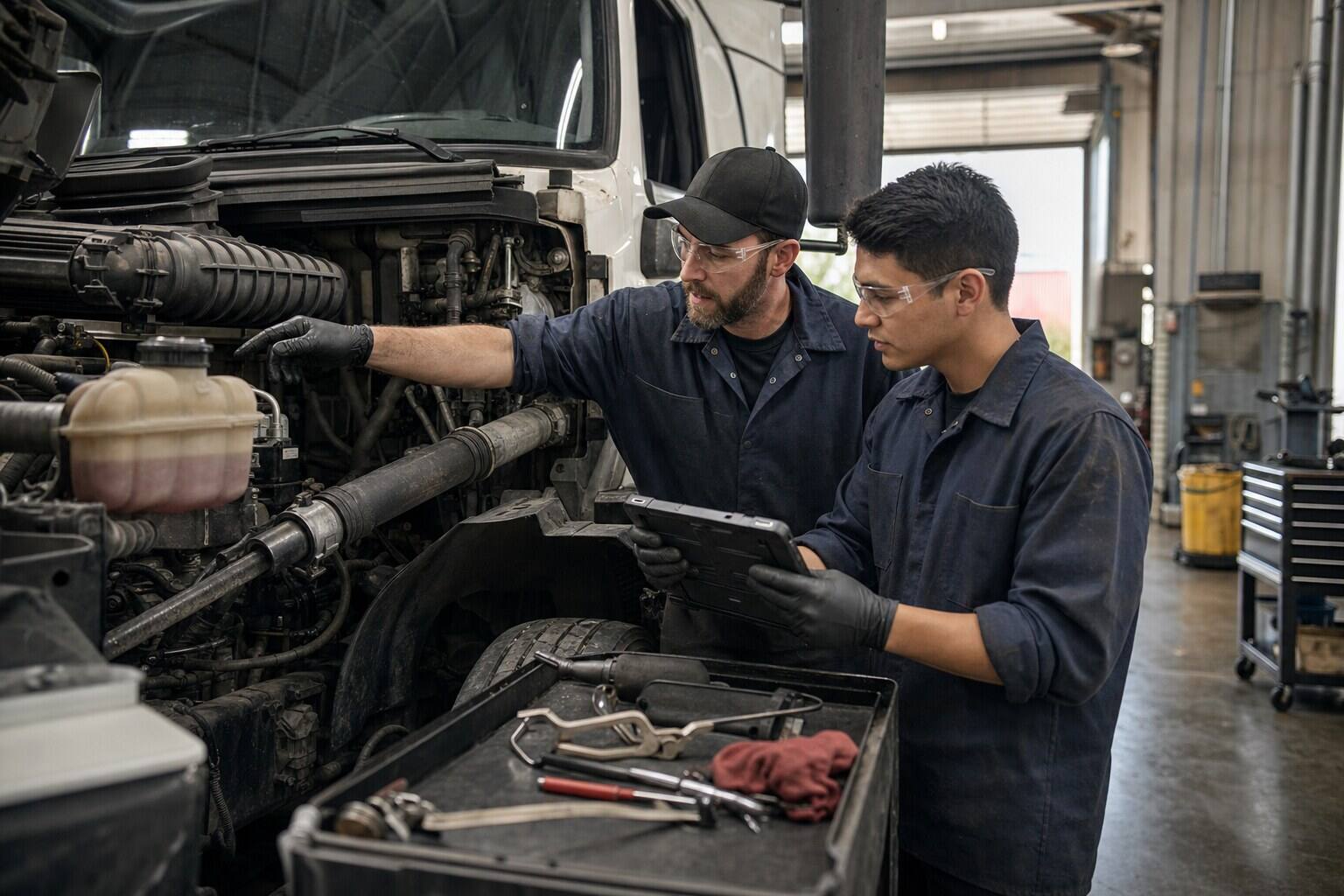
There isn't one required degree or a nationwide diesel mechanic license that everyone must earn before starting work. People enter the trade through employer training, registered apprenticeships, community colleges, private trade schools, manufacturer programs, and military experience.
If you're starting from scratch, all those choices can be confusing. The best route is usually the one that gives you real shop time, useful training, manageable costs, and a clear path to your first technician job. An expensive program isn't automatically better. Starting as a helper isn't automatically slower. What matters is the quality of the instruction, the equipment you can work on, and whether someone will help you move beyond basic maintenance.
The U.S. Bureau of Labor Statistics projects about 24,400 diesel technician openings per year from 2025 through 2035, with 4% employment growth over that decade. Many openings are expected to come from people changing occupations or leaving the workforce.
The 2026 TechForce technician workforce report also examines the training pipeline, reporting 11,947 diesel-program completions in the 2023–24 academic year. Its demand estimates use the earlier 2024–34 BLS outlook, so they should not be treated as the latest federal projections. National figures help describe the trade, but local employers and training quality matter more to your own first job.
That doesn't mean every school is worth the price or every entry-level job offers good training. This guide will help you compare the options and build a practical plan for getting into the trade.
A quick way to narrow down your options
If you need to earn a paycheck right away, start by looking for an employer-sponsored trainee role or registered apprenticeship. If local employers want formal training, compare public technical schools and community colleges before considering a more expensive private program. If you already know you want to work on one brand of truck or equipment, a manufacturer or dealer program may give you the most direct route.
These aren't hard rules. Read local job postings first. They will show you which qualifications employers in your area actually ask for, which is more useful than choosing a program based on national advertising.
What a diesel mechanic actually does
Diesel mechanics, also called diesel technicians or diesel service technicians, inspect, maintain, diagnose, and repair diesel-powered vehicles and equipment. The work involves much more than rebuilding engines.
Depending on the shop, a technician may work on:
- preventive maintenance and federal inspection items;
- air and hydraulic brake systems;
- steering, suspension, wheel ends, and drivetrains;
- electrical and electronic faults;
- emissions and aftertreatment systems;
- heating and air-conditioning systems;
- engines, fuel systems, cooling systems, and turbochargers;
- trailers, liftgates, refrigeration units, or auxiliary equipment; and
- computerized diagnostics, service documentation, and repair verification.
The BLS diesel technician profile notes that technicians use electronic diagnostic equipment alongside hand, power, pneumatic, welding, and machine tools. Mechanical ability matters, but so do electrical troubleshooting, computer skills, careful documentation, and safe work habits.
It's also physical work. Shops can be noisy, technicians handle heavy parts, and some repairs happen outside or at the roadside. Evening and weekend shifts are common in shops that support vehicles around the clock. When you visit a school or interview with an employer, pay attention to how people use lifting equipment, personal protective equipment, and repair procedures. A shop's safety habits will affect you every day.
First, choose the kind of equipment and shop you want
“Diesel mechanic” covers several different careers. You don't need to pick a permanent specialty before you begin. Still, knowing the main options will help you avoid paying for training that doesn't match the work you want.
Truck, trailer, and fleet maintenance
Fleet technicians maintain vehicles owned or leased by one organization. Entry-level work often starts with inspections, fluids, tires, brakes, lighting, and scheduled maintenance before moving into diagnostics and larger repairs.
This can be a strong entry path when the employer has a written technician progression, paid training, and experienced people assigned to coach new hires. Ask whether the shop performs major repairs itself or sends them to a dealer. The answer will tell you how much advanced work you're likely to see.
Dealership service
Truck and equipment dealerships often provide structured manufacturer training, current diagnostic software, and exposure to difficult repairs referred by other shops. The tradeoff is that you may specialize in one product line and work within tighter warranty, documentation, and productivity systems.
Dealer-affiliated college programs can combine both worlds. Caterpillar’s ThinkBIG program, for example, alternates college study with paid dealer experience. John Deere TECH combines classroom and hands-on training with a paid dealership internship. These are examples, not endorsements. Before committing, compare the local sponsorship rules, tuition, tool support, and employment terms.
Heavy equipment and field service
Heavy equipment technicians work on construction, agricultural, mining, material-handling, and similar machinery. The work may include diesel engines plus hydraulics, powertrains, electrical systems, and machine controls.
Field technicians travel to equipment that cannot easily come to a shop. That can mean more independence and variety, but also weather, driving, irregular conditions, and the need to make sound decisions without a full shop nearby.
Bus, transit, and government fleets
School districts, transit agencies, municipalities, and other public fleets maintain buses, trucks, emergency vehicles, and specialized equipment. These jobs may have formal hiring processes, background or driving requirements, and vehicle-specific certifications. They can also offer stable schedules, benefits, and structured advancement.
Power generation, marine, and other specialties
Diesel engines also power generators, commercial boats, pumps, and industrial equipment. These paths may require electrical, controls, or industry-specific knowledge beyond a standard truck curriculum.
Before choosing a school, ask which of these employers recruit from it and what equipment students actually diagnose and repair.
The main ways to become a diesel mechanic
There is no single correct route. Compare these options based on cost, paid work experience, training quality, and job placement. Don't let the advertising make the decision for you.
1. Start with an employer that trains entry-level technicians
Search for titles such as:
- diesel technician trainee;
- apprentice diesel technician;
- technician helper;
- preventive maintenance technician;
- lube technician;
- fleet maintenance trainee;
- trailer technician; or
- shop service assistant.
This route lets you earn while you learn. It may also include manufacturer classes or help with certification costs. The employer should be able to explain what you'll learn after six, twelve, and eighteen months. If the answer is vague, the training path may be vague too.
The risk is getting stuck doing fueling, cleaning, tires, or oil changes without a path into diagnostics and repair. Ask for specifics before accepting the job.
2. Complete a registered apprenticeship
A registered apprenticeship combines paid work, supervised on-the-job learning, progressive wages, and related instruction. The Department of Labor lists bus and truck mechanics and diesel engine specialists as an apprenticeable occupation. Program length and structure vary by sponsor, so check the actual requirements for each opening.
Use the federal Apprenticeship Job Finder, state apprenticeship offices, employer career pages, and local workforce agencies to look for openings. A job can use the word “apprentice” without being a registered apprenticeship. Ask about the wage schedule, instruction, supervision, credential, and completion requirements.
3. Attend a community college or public technical school
Community colleges often offer certificates and associate degrees in diesel technology, medium/heavy truck repair, or heavy equipment technology. A good program provides current equipment, substantial lab time, instructors with recent industry experience, employer partnerships, internships, and transparent completion and placement data.
This route may make sense if you need a broad foundation before an employer will hire you, want an associate degree, or can access grants and in-state tuition. Try to work in a shop, internship, or cooperative program while you're studying. Good grades help, but they don't replace experience on working equipment.
4. Attend a private trade school
Private programs may offer focused schedules, extensive recruiting relationships, and faster entry than a traditional degree program. They may also cost substantially more than nearby public options.
Before enrolling, get these answers in writing:
- What is the full cost after grants, including fees, tools, housing, and interest?
- How many clock hours are spent performing hands-on work?
- Which engines, vehicles, scan tools, and electrical trainers will you use?
- How large are lab groups?
- Which certifications are included, and who pays the test fees?
- Which local employers hired graduates during the last year?
- Is placement data independently reported, and what counts as a related job?
- Can credits transfer to another accredited school?
Tour the lab while students are working, not just during an open house. A clean showroom and a row of engines don't prove that students get enough time diagnosing real problems.
5. Use military mechanical experience
Military vehicle, power-generation, construction-equipment, and related maintenance experience can transfer well to civilian diesel work. Save training records and document the systems, equipment, inspections, diagnostics, leadership, and safety responsibilities you performed.
Translate military terminology into civilian shop language on your résumé. ASE may recognize qualifying military experience toward its work-experience requirement, but you must submit the required documentation for review.
Is diesel mechanic school worth it?
School can be worth it when it gives you access to equipment, instructors, employer relationships, and structured practice you can't get elsewhere at a reasonable cost. It's a much weaker investment when it creates heavy debt without providing substantial shop experience or a clear route to employment.
School is more likely to make sense if:
- local entry-level employers consistently prefer formal training;
- the program includes paid internships or dealer rotations;
- grants, employer sponsorship, veterans benefits, or low public tuition keep debt manageable;
- you need structured help with electrical fundamentals, diagnostics, or technical math; or
- the credential opens a specific dealership, equipment, or public-fleet path.
Starting with an employer may make more sense if:
- a reputable shop offers paid training and a documented progression;
- experienced technicians will supervise your work;
- you already have relevant mechanical, electrical, welding, military, or equipment experience;
- you learn well through structured hands-on work; and
- school would require debt that entry-level wages would make difficult to repay.
Don't compare “school” with “no education.” A strong employer route still requires study, practice, safety training, service information, and ongoing classes. Diesel technicians keep learning throughout their careers as engines, emissions systems, electronics, and diagnostic processes change.
Basic qualifications employers commonly look for
Requirements vary by equipment and employer, but many entry-level candidates will need:
- a high school diploma or equivalent;
- a valid driver’s license and an acceptable driving record;
- the ability to follow written procedures and interpret service information;
- basic mechanical, math, computer, and electrical knowledge;
- safe lifting and tool-use habits;
- reliable attendance and willingness to work the posted shift; and
- the ability to document work accurately.
Helpful high-school or introductory courses include automotive repair, diesel technology, electronics, algebra, physics, welding, and computer applications. BLS identifies a high school diploma as the typical entry-level education and classifies the occupation as requiring long-term on-the-job training.
Understand ASE certification before paying for tests
ASE certification is a professional credential, not a government-issued license to work as a diesel mechanic. Some employers value it heavily, some use it for raises or promotions, and others prioritize manufacturer training and demonstrated skill.
For Class 4 through Class 8 trucks, ASE’s Medium-Heavy Truck T-series includes:
- T2: Diesel Engines;
- T3: Drive Train;
- T4: Brakes;
- T5: Suspension and Steering;
- T6: Electrical/Electronic Systems;
- T7: Heating, Ventilation, and Air Conditioning; and
- T8: Preventive Maintenance Inspection.
T1 covers gasoline engines. Technicians who hold T2 through T8 earn Master Medium-Heavy Truck Technician status; T1 is not required for that designation. ASE requires recertification every five years.
Passing a test is only part of certification. ASE also requires relevant hands-on experience or an approved combination of training and experience. Its work-experience instructions list two years of full-time repair-technician experience for T1 through T8, although qualifying formal education may replace part of that requirement. You can take most tests before completing the experience, but ASE won't issue the certification until it approves your experience.
For an early-career technician, the best first test depends on the job:
- T8 aligns with preventive-maintenance and inspection work;
- T4 and T5 align with brake, steering, suspension, and wheel-end work;
- T6 supports the electrical troubleshooting required across modern equipment; and
- T2 becomes especially relevant as you move into engine diagnosis and repair.
Ask whether the employer requires a test, pays the fees, provides study materials, offers a raise for passing, and gives you work that builds the required experience.
CDL and EPA credentials: when they matter
A commercial driver’s license is not a universal prerequisite for diesel mechanics. FMCSA guidance says mechanics and shop personnel need the appropriate CDL when they operate or test-drive a vehicle subject to CDL rules on a public highway.
Some employers require a CDL at hire, some give technicians time to obtain it, and others limit road tests to designated drivers. Read the posting carefully and ask whether the company provides training, a vehicle for testing, and paid test time.
If you'll service motor-vehicle air-conditioning systems for payment, federal rules require the appropriate training and certification. The EPA explains that technicians working on MVAC systems must complete an approved program and pass a Section 609 certification test. Section 608 covers different refrigeration equipment and isn't interchangeable with Section 609.
State inspection licenses, DOT medical qualification, brake-inspector qualifications, and employer- or equipment-specific credentials may also apply. Treat each job posting as its own checklist.
Do diesel mechanics have to buy their own tools?
Many shops expect technicians to own common hand tools while providing expensive diagnostic equipment, lifts, jacks, shop presses, specialty tooling, and software. Other employers provide a larger share of the tool set, especially for trainees, public fleets, field service, or union roles.
Before buying anything, request the employer’s minimum tool list and ask what safety equipment the shop provides. A reasonable starter tool set may include:
- combination wrenches in SAE and metric sizes;
- 3/8-inch and 1/2-inch drive sockets and ratchets;
- basic extensions, adapters, and breaker bars;
- screwdrivers, pliers, cutters, locking pliers, and picks;
- hammers, pry bars, punches, and measuring tools;
- a multimeter appropriate for the work, if the employer expects you to supply one; and
- a secure box or cart sized for the tools you actually own.
Don't finance an oversized premium toolbox just to look established. Buy for the work in front of you. Choose tools with warranty support you can actually use locally, then upgrade the tools you use hard enough to justify it. Don't buy specialty tools until you know the shop won't provide them.
Ask specifically who supplies scan tools, laptops, software subscriptions, torque wrenches, air-conditioning equipment, heavy sockets, pullers, lifting equipment, and field-service equipment.
How long does it take to become a diesel mechanic?
There isn't one honest answer because “become” can mean several things.
You can begin earning in an entry-level maintenance or helper role as soon as an employer hires you. A certificate or manufacturer program may prepare you for an entry-level technician role on a different timeline. A registered apprenticeship may span several years. Becoming an independent diagnostic technician who can safely handle unfamiliar faults takes continued experience after any initial program.
It helps to think about the career in stages:
- Entry: Learn shop safety, inspections, fluids, filters, tires, basic electrical testing, and accurate documentation.
- Developing technician: Perform brakes, suspension, aftertreatment work, component replacement, and guided diagnostics.
- Independent technician: Diagnose across systems, use service information efficiently, verify repairs, and manage more complex jobs.
- Advanced or specialized technician: Take on engine, electrical, emissions, hydraulic, field-service, or manufacturer-specific diagnostic work.
- Leadership or ownership: Move toward lead technician, trainer, foreman, service management, fleet management, technical support, or an independent business.
Progress is based on demonstrated competence, not time alone. Ask potential employers how they evaluate advancement and what training accompanies each level.
How to get your first diesel technician job
Build evidence, even before you have formal experience
A hiring manager can't see “mechanically inclined” on a résumé. Give them evidence instead:
- maintenance or repair projects you completed safely;
- automotive, agricultural, construction, military, or industrial equipment experience;
- shop, welding, electrical, or technical courses;
- internship, volunteer, or supervised lab work;
- a clean driving record;
- relevant certifications already earned; and
- examples of reliable attendance, documentation, and problem-solving.
Don't exaggerate. An employer would rather hear, “I can perform an inspection with supervision and explain what I'm checking,” than discover that you overstated your diagnostic experience.
Search beyond one job title
Browse current diesel mechanic jobs, but also search employer sites for trainee, helper, PM technician, fleet technician, trailer technician, field-service trainee, and equipment-technician roles. Look at diesel jobs by category and diesel jobs by state to understand what employers near you repeatedly request.
Tailor the résumé to the equipment
A transit fleet, truck dealership, construction-equipment dealer, and generator company do not need identical résumés. Put the most relevant systems, equipment, driving qualifications, shifts, and training first.
Ask better interview questions
Use the interview to evaluate the training path, not only the starting wage:
- What work does a new technician handle during the first 90 days?
- Who checks my work and answers diagnostic questions?
- Is there a written technician-level or wage progression?
- Which training and certification costs does the company pay?
- What tools must I own on the first day and after the first year?
- Does the shop perform engine and advanced diagnostic work internally?
- What shifts, weekend rotations, overtime, road calls, or travel should I expect?
- Is a CDL required, preferred, or available through company training?
- How many technicians have advanced from this entry role during the last two years?
Clear, specific answers are a good sign. “We'll see how it goes” is not a training plan.
What to do this week
- Choose two target paths, such as fleet maintenance and heavy equipment, instead of applying to everything blindly.
- Read at least twenty local job postings and record repeated requirements for experience, tools, CDL, certifications, shifts, and equipment.
- Identify three employers that advertise training or technician progression.
- Compare one public-school program, one paid employer route, and any registered apprenticeship available locally.
- Calculate the full cost and lost earnings of each school option.
- Build a one-page résumé using specific equipment, projects, safety experience, and transferable skills.
- Apply to appropriate entry-level roles and follow the employer’s stated process.
- Keep a list of the technical gaps employers mention; use it to choose your next course or certification.
Frequently asked questions
Can I become a diesel mechanic without going to school?
Yes. BLS says most diesel technicians learn on the job after high school, although some employers prefer candidates who completed postsecondary diesel training. Look for an employer with supervised training and a specific progression beyond basic maintenance.
Do I need ASE certification before applying?
Usually not for a true entry-level job, but requirements vary. You can't receive most professional ASE certifications based on a test alone. You'll also need relevant work experience or an approved combination of training and experience. Some employers hire first and pay for testing later.
Do I need a CDL?
Not for every diesel job. It may be required if you operate or test-drive qualifying commercial vehicles on public roads. Some employers require it at hire, while others help technicians earn it.
Is diesel mechanic work only about engines?
No. Entry-level and experienced technicians commonly work on brakes, suspension, steering, electrical systems, preventive maintenance, emissions equipment, drivetrains, HVAC, trailers, hydraulics, and computerized diagnostics.
How much can a diesel mechanic make?
Pay changes with location, specialty, experience, shift, overtime, and employer. Use the Diesel Mechanic Salary Guide for current national, state, industry, and percentile comparisons rather than relying on one advertised average.
What is the best first diesel mechanic job?
The best first job is one where you can work safely, receive regular supervision, build progressively harder skills, and understand how your pay and responsibilities can advance. A famous employer or expensive school is less important than the quality of the actual training path.
The bottom line
Becoming a diesel mechanic isn't simply a choice between “school” and “no school.” You're choosing how to combine instruction, paid experience, credentials, tools, and employer support.
Start with the kind of work you want to do. Read local job postings and compare the full cost of each training path. Then choose the route that gets you into a real shop without taking on more debt than you need.
Your first job doesn't need to be perfect. It does need to be safe, give you useful experience, and lead somewhere. If an employer can show you how new technicians learn and advance, that's worth paying attention to.
When you are ready to compare openings, browse all current diesel mechanic jobs or narrow the search by state and job category.