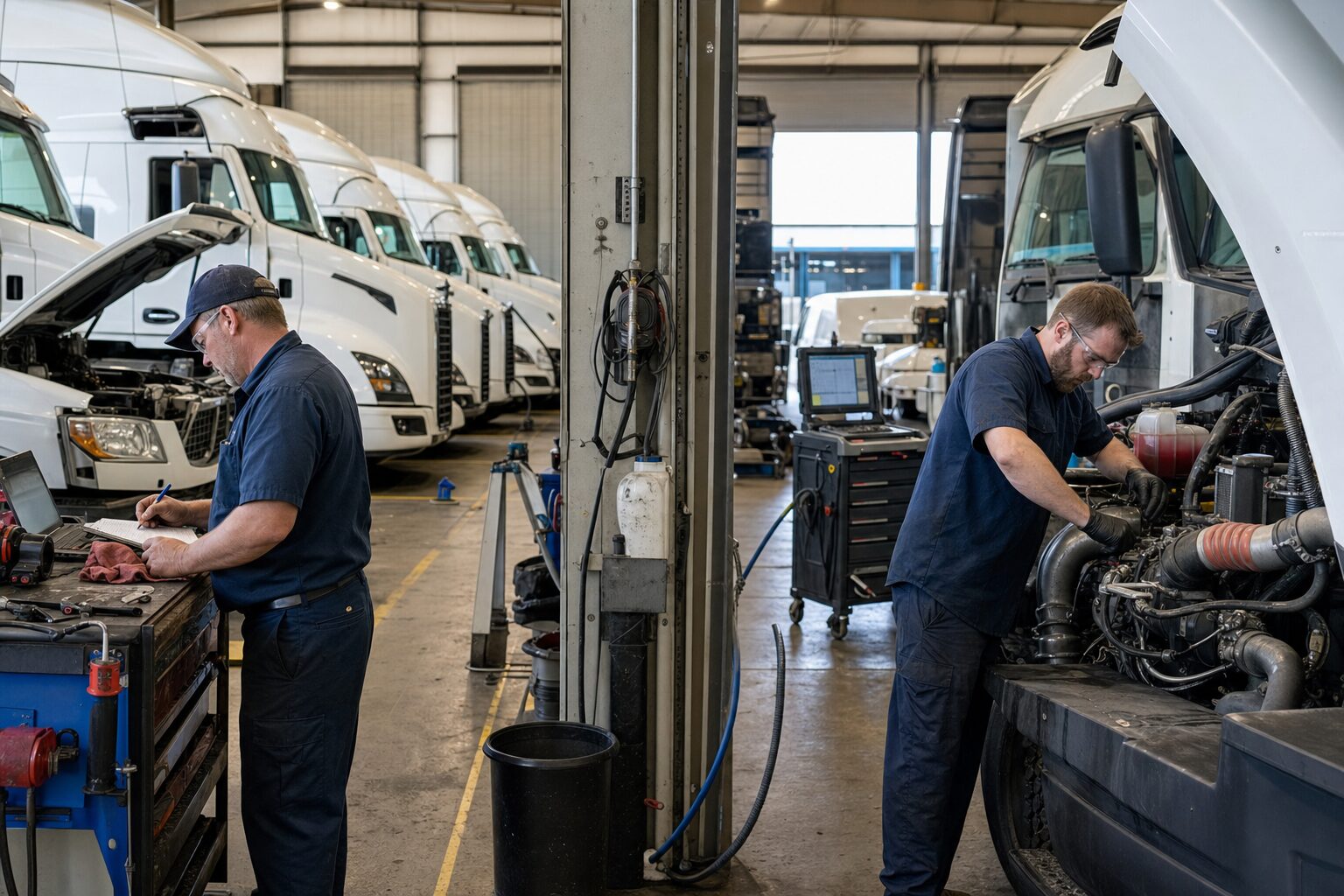
You have two offers. One is from a carrier that maintains its own tractors and trailers. The other is from a truck dealership across town.
The fleet promises steady hourly pay and familiar equipment. The dealer talks about factory training, difficult diagnostics, and a faster path to advanced work. Both managers say there is plenty of overtime. Both say they promote from within. Both claim their shop is like a family.
That still does not tell you where you should work.
The useful difference is not the name over the door. It is what the shop repairs, how technicians are paid, what gets sent elsewhere, who teaches you, and what happens when a job takes longer than expected.
The short answer
A fleet shop may fit you better if you want to learn a known group of vehicles, see the results of your repairs over time, and work toward keeping an operation reliable. Fleet work often includes a large share of preventive maintenance, inspections, brakes, electrical repairs, aftertreatment, trailers, and recurring failures. You may have less customer interaction, but the drivers, dispatchers, and operations managers are still your customers inside the company.
A truck dealership may fit you better if you want deeper exposure to a manufacturer, current service information, warranty procedures, programming, and difficult repairs that other shops could not complete. Dealer work can provide a strong technical education, but it may also bring tighter documentation standards, customer approval delays, productivity targets, and pay plans that need careful explanation.
Neither setting is automatically better for a new technician or an experienced one. A fleet that performs advanced repairs in-house can teach you more than a dealer that keeps you on basic work. A dealer with a real mentor can be a better first job than a fleet where everyone is too busy to train you.
Judge the shop, not the category.
What each shop is trying to accomplish
The business model changes the pressure you feel in the bay.
A fleet owns or controls the equipment it maintains. Its maintenance department exists to keep trucks available, safe, and economical over their working lives. The shop may track preventive-maintenance compliance, roadside failures, repeat repairs, cost per mile, vehicle availability, and how long units sit waiting for parts.
That creates a long relationship with the equipment. You may inspect the same tractor every few months, learn its repair history, recognize patterns across similar units, and find out whether your last repair held up. When the company keeps vehicles for years, good technicians can prevent failures instead of only reacting to them.
A dealership sells repair service to customers and supports one or more truck brands. Its shop has to diagnose the complaint, prepare an estimate, get authorization, follow warranty or manufacturer procedures, document the work, and return the truck. The customer may be an owner-operator with one truck or a large fleet with a service agreement.
That creates a different kind of pressure. A truck in your bay may already have defeated another technician. The customer wants it earning money again. The service department needs accurate findings, available parts, labor time it can explain to the customer or a warranty auditor, and repair notes that support the work performed.
Neither pressure is easy. Fleet pressure comes from keeping an operation moving. Dealer pressure comes from solving customer problems while producing billable work. Ask yourself which kind of responsibility you would rather carry.
What a normal week can look like in a fleet shop
Imagine a regional delivery fleet with several makes of tractors, dry vans, liftgates, and a few refrigerated units.
You might begin Monday with scheduled services and annual-inspection items. A driver then reports an intermittent ABS light. After that comes a no-start in the yard, a liftgate hydraulic leak, and a tractor that will not complete a regeneration. Before the shift ends, you find abnormal tire wear that points to a suspension or alignment problem.
Fleet technicians often see a mix of:
- preventive maintenance and inspection work;
- brakes, wheel ends, steering, suspension, and tires;
- starting, charging, lighting, wiring, and network faults;
- aftertreatment and drivability complaints;
- trailer, liftgate, reefer, and auxiliary-equipment repairs;
- breakdowns and road-service support; and
- repair documentation tied to the unit's history.
The mix varies enormously. One fleet rebuilds engines and transmissions. Another sends nearly every major repair to a dealer. One gives developing technicians a written progression. Another keeps them on services because the shop is short-handed and needs the inspection lane moving.
The question that reveals the job is: What percentage of repairs does this shop complete in-house?
Follow it with examples. Ask where engine, transmission, aftertreatment, multiplex, and major electrical jobs went during the last month. A manager who can walk you through recent work orders will tell you more than a recruiting slogan.
What a normal week can look like at a truck dealership
At a dealership, the trucks arriving each day may share a badge but not a history. One customer needs a manufacturer campaign or recall completed during a scheduled service. Another has an intermittent fault that appears only under load. A third truck was towed in after another shop replaced parts without fixing the complaint.
You may spend the week on:
- manufacturer campaigns and warranty repairs;
- engine, aftertreatment, electrical, and network diagnosis;
- programming, parameter changes, and software updates;
- chassis, brake, steering, suspension, and driveline work;
- customer-paid inspections and repairs;
- new-truck preparation or used-truck reconditioning; and
- detailed repair-order notes documenting the complaint, cause, correction, and test results.
Dealership access to factory systems can be valuable. The Peterbilt Technician Institute, for example, teaches manufacturer diagnostic systems, electrical diagnosis, PACCAR engines, chassis systems, and preventive maintenance for technicians entering its dealer network. Other manufacturers and dealer groups run their own programs.
Do not assume every dealership gives every technician immediate access to that training. Ask which courses someone at your level would take in the first year, whether training time and travel are paid, and what new work you become eligible to perform after completing it.
Also ask how work is assigned. Some dealers rotate jobs to build broad technicians. Others have separate engine, electrical, express-service, mobile, or used-truck teams. Specialization can make you very good at a system, but it can also narrow your experience if you stay in one lane for too long.
Which setting offers better technical growth?
The better learning environment is the one that combines useful work with increasing responsibility and available help.
A fleet can build strong diagnostic habits because you see repeat equipment and can compare one unit with another. You learn how maintenance decisions affect breakdowns, drivers, routes, fuel use, and vehicle life. Mixed fleets can expose you to several engines, transmissions, brake systems, trailers, and diagnostic platforms.
The risk is that major work may be outsourced. If your shop sends every internal engine repair, transmission problem, difficult electrical fault, and warranty-covered aftertreatment issue away, you may reach a ceiling unless the employer has another path for you.
A dealership can expose you to factory service information, technical support, current software, special tools, and repairs referred by fleets or independent shops. You may learn one product line in unusual depth and see problems that a general fleet shop encounters only occasionally.
The risk is getting boxed into repetitive work while the most experienced technicians receive every difficult diagnosis. Factory training on a résumé sounds good, but it is not a substitute for using the training on actual repairs.
Look for evidence of progression:
- Who decides when you move beyond preventive maintenance?
- Is a senior technician given time to review your diagnosis?
- Which repairs would you be expected to handle after six months?
- Does completing training or certification change your pay or job level?
- Can you show an example of someone who advanced through this shop?
The ASE Medium-Heavy Truck T-series can support development in either setting, but ASE does not determine your job level. Ask whether the employer pays ASE registration and test fees, provides study time, offers a raise for passing, or uses its own skills assessment. The guide to diesel technician levels explains how to compare the responsibility behind titles such as Technician II, Technician III, Mechanic B, and Mechanic A.
Compare the pay system, not just the advertised number
An hourly rate is only one part of the offer.
Fleet positions are often hourly, sometimes with shift differentials, scheduled overtime, call-out pay, or road-service premiums. Dealerships may use hourly pay, flat rate, hourly pay plus an efficiency bonus, or another performance plan. None of those structures is automatically fair or unfair. The details decide.
For an hourly offer, ask:
- How many hours are guaranteed each week?
- How much overtime did technicians on this shift actually average in the last eight weeks?
- What is the shift differential, and when does it apply?
- Are breaks, training, meetings, road tests, and travel between locations paid?
- How are call-outs, mobile work, and weekend rotations paid?
For a flat-rate or incentive offer, go further:
- How are jobs dispatched?
- How many billed or "flagged" hours did technicians at my expected level average during the last three months?
- Is there a weekly guarantee while I learn the system?
- How are diagnostic time, warranty work, campaigns, and waiting for approval handled?
- Who absorbs lost time when the wrong part is ordered or a truck blocks the bay?
- How are comebacks, when a truck returns because the original problem was not fixed, reviewed and charged?
- Is required training paid, and does it reduce my production target?
Do not build your budget around the best week in the shop. Ask for the normal range for technicians doing the work you would receive, not the top producer's annual earnings.
For example, a $36 hourly offer with 40 guaranteed hours produces $1,440 in gross weekly base pay before overtime. A $42 flat-rate offer produces $1,680 only if you flag 40 hours. At 30 flagged hours, it produces $1,260. That does not make one plan better, but it shows why the pay formula, available work, and guarantee matter as much as the posted rate.
Then compare the whole offer. Include health coverage, retirement contributions, paid time off, tool support, uniforms, boot allowance, training, commute, shift, overtime, and the likely cost of changing your tool setup. Use the Diesel Mechanic Salary Guide for location and industry context, but compare the actual offers dollar by dollar.
Schedules are driven by the customers, even in a fleet
Fleet work is sometimes described as predictable. It can be, but the fleet's operating schedule controls the maintenance window.
If trucks leave every morning, the shop may perform heavier work in the afternoon, overnight, or on weekends. A first-shift opening can still include a rotating Saturday, emergency calls, snow events, or holiday coverage. Seniority may affect when a preferred shift becomes available.
Dealership schedules also vary. Some locations keep ordinary business hours. Others operate two or three shifts because customers cannot wait until morning. The Bureau of Labor Statistics notes that some truck and bus repair shops provide 24-hour service and that evening and weekend work occurs in the occupation.
Ask for the exact schedule in writing:
- Which days and hours would I work during the first 90 days?
- Is the shift permanent, rotating, or based on seniority?
- How often did this team work an unscheduled weekend last quarter?
- Is overtime voluntary, assigned, or simply expected?
- Who covers road calls after the shop closes?
"Some overtime" is not an answer. A manager should be able to describe what the team actually worked.
Tool and diagnostic policies can change the value of the job
Two offers with the same wage can leave you in very different financial positions.
Many shops expect technicians to own common hand tools while the employer supplies lifts, jacks, presses, specialty tooling, diagnostic laptops, adapters, and licensed software. The dividing line changes by employer. Field technicians may also need a different personal setup than shop technicians.
Before accepting, get the required tool list and ask:
- Which tools must be in my box on the first day?
- Which tools can I add as my responsibilities grow?
- Who supplies scan tools, communication adapters, laptops, and software subscriptions?
- Who supplies calibrated torque tools and manufacturer-specific equipment?
- Is there an annual allowance, reimbursement program, or purchase plan?
- If the company pays for a tool, who owns it when I leave?
- Are personal tools insured against theft, fire, or shop damage?
- Does the employer replace a personal tool that breaks during normal work?
A tool allowance is not worth its advertised amount if it requires expensive purchases you would not otherwise make, has a long vesting rule, or excludes the tools you need. Ask to see the written policy.
Training promises need dates and names
"We offer training" can mean a scheduled manufacturer course with paid travel. It can also mean watching another technician whenever both of you have time.
Dealers often have the clearest route to brand-specific credentials. That can be especially valuable if you want to become the person who handles advanced electrical, engine, aftertreatment, or programming work for that manufacturer.
Fleet training can be just as structured. It may include vendor classes, ASE support, CDL training, apprenticeship, safety qualifications, and progression through defined technician levels. Apprenticeship.gov has profiled a Ryder Systems diesel technician registered apprenticeship, which is a useful reminder that paid development is not limited to dealerships.
Ask four questions:
- What training is already scheduled for this position?
- Who pays for the course, travel, lodging, and work time?
- Which technician completed it most recently?
- What work or pay becomes available after completion?
Specific answers show that the program exists. Vague answers show that it may be a future intention.
How to tell whether the shop itself is healthy
The difference between a good fleet and a bad fleet is larger than the difference between fleets and dealerships. The same is true for dealers.
During a shop tour, pay attention to ordinary work:
- Are jack stands, lifting equipment, ventilation, spill control, and lockout procedures actually used?
- Can technicians access current service information without sharing one outdated login?
- Are diagnostic laptops working and legally licensed?
- Are parts staged and labeled, or do repairs stall because nobody can find anything?
- Do completed work orders explain what was tested and verified?
- Is there a place for a new technician to ask questions without being humiliated?
- Are broken shop tools repaired, or does everyone work around them?
- Do technicians appear rushed into releasing unsafe equipment?
Ask to meet someone doing the level of work you would enter. A five-minute conversation can uncover more than an hour with a recruiter. Ask that technician what they repaired last week, what gets sent out, and what they wish they had known before starting.
Red flags include a trainee title paired with solo road calls, no clear answer about pay calculations, required diagnostic software on a personal laptop, constant pressure to skip inspection items, and a mentor who is expected to train while carrying a full production load.
Can you move from a fleet to a dealership later?
Yes. The systems do not change just because the owner of the truck changes.
A fleet technician can bring preventive-maintenance discipline, knowledge of vehicle history, mixed-equipment experience, and an understanding of how downtime affects an operation. The adjustment may be learning a manufacturer's procedures, warranty documentation, customer approval and billing processes, and tighter time tracking.
A dealership technician can bring deep product knowledge, advanced diagnostics, factory systems, programming experience, and strong repair documentation. The adjustment may be taking broader ownership of inspections, trailers, auxiliary equipment, mixed brands, and the long-term reliability of the same units.
Keep a private skills record that does not contain customer or employer-confidential information. Record the system, complaint, tests performed, repair, final verification, training used, and amount of supervision. That gives you evidence when you apply for a different shop or a higher technician level.
If test-driving commercial vehicles is part of either job, verify the license requirement. The Federal Motor Carrier Safety Administration explains that mechanics need the appropriate CDL when operating or test-driving a vehicle subject to CDL rules on a public highway. Ask whether the employer pays for training and allows time to obtain it.
Who is usually happier in a fleet shop?
A fleet may suit you if you like:
- learning the history and failure patterns of a known group of vehicles;
- preventing breakdowns, not only repairing them;
- seeing whether your repair lasted;
- working with drivers and operations as an internal team;
- a pay plan based mostly on clock hours; and
- building broad skills across trucks, trailers, and support equipment.
Be cautious if you dislike repetitive inspections, want constant exposure to new models, or need advanced engine and diagnostic work that the fleet sends outside.
Who is usually happier at a dealership?
A dealership may suit you if you like:
- developing deep knowledge of a truck or engine family;
- difficult faults and work referred by other shops;
- factory service information, special tools, and technical support;
- precise documentation and structured repair procedures;
- customer-facing problem solving; and
- performance pay when the work supply and dispatch system are fair.
Be cautious if you dislike close time tracking, warranty documentation, changing customer priorities, or specializing within one brand and department.
Questions to ask before accepting either job
You do not need to ask every question in one breath. Pick the ones that could change your decision and request concrete examples.
About the work
- What were the five most common repairs in this shop last month?
- What difficult repair did the team complete recently?
- Which jobs are sent to another shop or department?
- How much of my first six months would be preventive maintenance, repair, and diagnosis?
- Would I work on trailers, reefers, liftgates, road calls, or only tractors?
About pay and schedule
- Can you walk me through a normal paycheck for someone at this level?
- What did technicians on this shift average in hours and overtime recently?
- How are bonuses, flagged hours, warranty time, and comebacks calculated?
- What shift am I actually accepting, and how can it change?
- How often is weekend, holiday, or on-call coverage required?
About development
- Who would check my work and help when a diagnosis stalls?
- What training would I complete in the first year?
- What skills are required for the next level?
- When did the last person advance, and what did they have to demonstrate?
- Does the company pay for ASE, CDL, inspection, or manufacturer credentials?
About tools and safety
- May I see the required personal-tool list and written allowance policy?
- Which diagnostic and specialty tools belong to the shop?
- How are personal tools protected and insured?
- What happens when the safe repair takes longer than the estimate?
- Who has final authority to keep an unsafe truck out of service?
The answer to that last question matters more than the break-room snacks.
A simple way to compare two offers
Give yourself one quiet hour after both interviews. Write down what each employer proved, what it merely promised, and what remains unknown.
Then compare five things:
- The first-year work: What will you actually repair, and how quickly can that responsibility grow?
- The dependable pay: What can you expect in an ordinary month without relying on maximum overtime or an exceptional bonus?
- The people available to teach you: Who has both the skill and the time to help?
- The cost of doing the job: Tools, commute, schedule disruption, unpaid time, and benefits all count.
- The next credible step: What specific skill, credential, or result moves you forward?
If one offer is still vague, ask follow-up questions before deciding. A serious manager will understand why a technician wants to know how work, pay, and training operate.
Frequently asked questions
Do fleet technicians or dealership technicians make more?
Either can pay more. Location, experience, shift, overtime, specialty, pay structure, and employer matter more than the label. Compare ordinary annual earnings and benefits, not a dealer's maximum production example against a fleet's base hourly rate.
Is a dealership always better for a new diesel technician?
No. A dealership with manufacturer training and patient mentors can be an excellent start. So can a fleet with a written progression, varied in-house repairs, and senior technicians assigned to develop new hires. Ask what work beginners performed and learned during the last year.
Will fleet work limit my diagnostic skills?
It depends on what the fleet keeps in-house. A fleet that diagnoses electrical, network, aftertreatment, engine, and driveline problems can build strong technicians. A shop that outsources every difficult fault may limit growth unless it provides another route into advanced work.
Are all dealership diesel technicians paid flat rate?
No. Heavy-duty dealers use several pay systems, including hourly, flat rate, hourly plus incentives, and guarantees for certain roles or training periods. Get the formula and examples in writing before comparing the offer.
Where should I search for both kinds of jobs?
Browse current fleet diesel mechanic jobs and truck and trailer technician jobs, then read the full posting for the repair mix, shift, tool requirements, training, road service, and pay structure. If you are still deciding where to enter the trade, start with the broader guide on how to become a diesel mechanic.
Choose the shop that can show its work
Fleet shops and truck dealerships can both build excellent careers. They can also both waste a technician's time.
The better employer should be able to show you the work you will perform, explain how you will be paid, introduce the person who will help you grow, and describe the next level in plain language. You should leave the interview knowing what your first shift, first toolbox, first training course, and first raise path look like.
That is a stronger reason to accept an offer than the word fleet or dealership on the building.