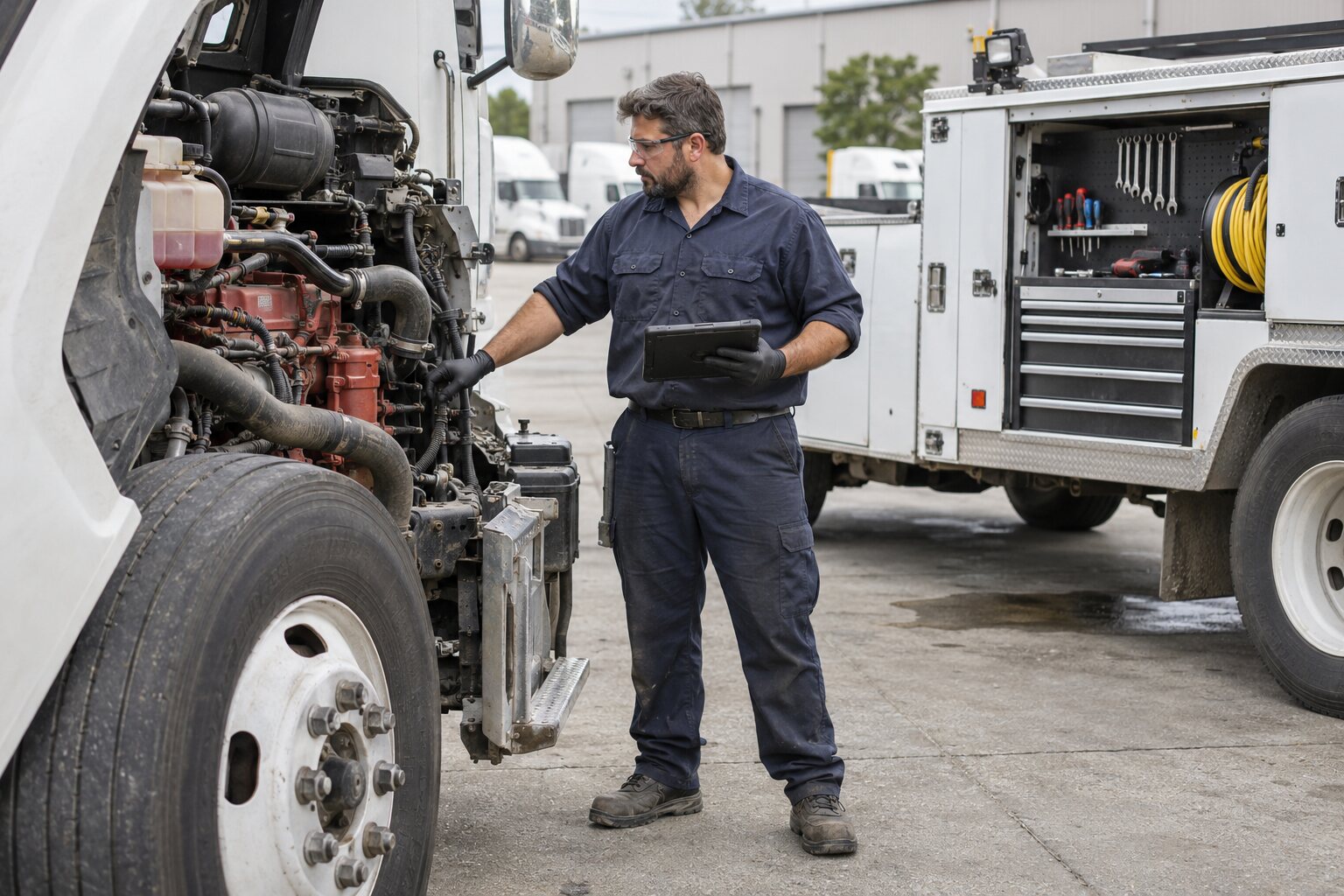
A mobile job can sound appealing when you've spent another shift waiting for a bay, sharing a diagnostic laptop, or getting interrupted halfway through a repair. If the offer includes a well-equipped service truck, more independence, and a pay increase, it's worth a look.
But take the interview past the truck and the pay rate. Find out who answers when you need help, who brings the part you don't have, and what happens when the last call arrives ten minutes before you're supposed to head home.
Those details will shape your week. When you're comparing mobile roles as an employee, here's what to settle before leaving the shop.
First, find out what “mobile” means at this employer
A mobile diesel technician travels to equipment to inspect, diagnose, maintain, or repair it. The title covers several different jobs, sometimes within the same company.
Scheduled fleet maintenance might mean visiting customer yards for services, inspections, brakes, electrical repairs, and other planned work. You may know tomorrow's locations before you finish today.
Roadside breakdown service is driven by trucks that cannot continue their trips. The location, complaint, available parts, and finish time can be much harder to predict.
Dealer or equipment field service may involve construction sites, farms, or customer facilities, with a mix of diagnostics, warranty work, and repairs on a particular product line.
A posting can combine all three. Ask what share of the team's recent work was scheduled maintenance, breakdowns, and larger repairs. Then ask where technicians performed it: a fleet yard, a customer shop, a jobsite, or the shoulder of a road.
Try this question: “Can you walk me through one technician's last full week, including the calls that ran late?” It's harder to misunderstand a real schedule than a phrase like “flexible hours.”
Get the territory explained in driving time, too. A customer 60 miles away can mean something different in city traffic than on an open interstate. Find out how far the last appointment can take you from home and whether overnight stays are part of the job. Our road-service jobs and travel jobs can help you compare postings, but confirm the arrangement with each company.
Get a sample day explained from clock-in to clock-out
The advertised rate doesn't tell you enough about a mobile offer. You need to know how the company records and pays for the work surrounding the repair.
Ask the manager to explain a day that includes loading the truck, driving to a customer, diagnosing the complaint, collecting a part, completing the repair, and writing the work order. Where does the paid day begin and end? How do you record each activity?
Be specific about:
- Travel between customers, parts runs, and return trips to the branch.
- Stocking, cleaning, and maintaining the service truck.
- Customer authorization delays and waiting for equipment to become available.
- Diagnostic notes, photos, estimates, and calls with technical support.
- Training, meetings, and work that cannot be billed to a customer.
Billable hours and hours worked are different measures. A customer's invoice may exclude a parts delay or internal paperwork. That doesn't settle how your working time must be recorded or paid.
The U.S. Department of Labor's hours-worked guidance treats travel between jobs during the workday as work time and distinguishes it from ordinary commuting. Its travel-time guidance also explains that taking an employer's vehicle home does not automatically make the commute paid time. Your duties and circumstances matter, and state rules may differ.
Get the overtime terms in writing, including the rate and when it starts. Eligibility can depend on the employer and your duties. The Department of Labor lists federal overtime exemptions that can affect certain dealership mechanics, so an hourly offer alone doesn't establish your overtime entitlement. If the employer says the position is exempt, have them explain the basis and how applicable state rules are handled.
If there's an efficiency bonus, find out whether driving, training, parts delays, or a customer cancellation affect it. Ask what a technician doing your expected work normally earns before incentives and how many paid hours are guaranteed in a slow week.
For perspective, an extra $3 an hour is $120 gross over 40 paid hours, before overtime or bonuses. Compare that increase with any changes in health premiums, tool expenses, commuting, and guaranteed hours. Use the diesel mechanic pay calculator once you have the actual terms.
Turn “occasional on-call” into a schedule you can picture
“Everyone takes a turn” leaves plenty unanswered. A rotation shared by six technicians is different from one shared by two, especially when someone is on vacation.
Ask how often you'd carry the phone, how many calls the last rotation received, and what response time the employer expects. Find out whether you're covering a few nearby customers or a large territory. Does another technician take over if two calls arrive at once?
Then discuss the pay. Standby pay, call-out minimums, weekend premiums, and pay for the actual work are separate details. If there's a two-hour call-out minimum, for example, does that cover travel and repair time together, or is it an additional payment? Under the Department of Labor's on-call guidance, whether restricted standby time counts as working time depends on the circumstances.
The question many people forget is what happens the next morning. If a call keeps you out until 2 a.m., who changes your first appointment? Who makes that decision, and how does dispatch learn about it?
Ask about vacation coverage and after-hours customer calls too. A company phone can make work convenient, but you should know whether you're expected to answer it when another technician is on call.
Look inside the service truck before you accept
Ask to see a truck equipped for the position you're discussing. If your assigned truck isn't available yet, ask for its equipment list and a date when you can inspect it.
Look beyond the number of drawers. Can you reach tools without unloading half the truck? Is there secure storage for your own equipment? Is the lighting useful for evening work? Who deals with a failed compressor, dead laptop, worn tire, or service vehicle that needs repairs?
Have the employer identify who supplies:
- Hand tools, torque tools, specialty sockets, pullers, and test leads.
- Diagnostic laptops, interfaces, current software subscriptions, and service information.
- A phone or tablet, data service, and connectivity at customer locations.
- The lifting and support equipment appropriate for the assigned work.
- Protective equipment, spill supplies, and arrangements for used fluids and other waste.
Ask how you obtain equipment that doesn't live on the truck. There should be a workable plan for a repair that needs a second person, a shop bay, or a special tool.
“Company truck provided” still leaves details to settle. Confirm who covers fuel, tolls, parking, maintenance, and breakdowns, and where the truck stays overnight. If you take it home, ask about personal use and whether your property has to meet any parking requirements.
For your own tools, get the minimum list before buying anything. Ask about allowances, theft coverage, inventory records, and what happens to your equipment when the service truck is at another branch or repair facility.
Find out who handles parts and repair approvals
Start with what dispatch gives you before you leave. Will you have the unit number or VIN, a useful complaint, the exact location, a contact who can provide access, and any existing diagnosis? Arriving at a locked yard with a vague “won't run” ticket can waste the time you needed for the repair.
Then picture a no-start that needs a component your truck doesn't carry. Somebody has to identify it, check availability, get approval, collect it, and decide what happens to your next appointment.
Find out who handles each step. A dedicated parts person or delivery route can make a large difference to how much time you spend repairing equipment. If you handle parts runs yourself, find out how that time is recorded and how dispatch adjusts the schedule. Include restocking, warranty parts, and core returns in that conversation, so those tasks have time assigned to them too.
Ask who approves additional diagnostic time and repairs beyond the original complaint. Can you contact the fleet manager directly? Does a service writer prepare the estimate? What do you do when nobody with purchasing authority answers?
A useful follow-up is: “What happened on the last call where the technician couldn't get the part that day?” Listen for a clear handoff, a return-visit plan, and someone keeping the customer informed.
You should also understand how the company judges productivity. Ask whether targets account for distance, equipment condition, diagnosis, and documentation. A technician making six nearby inspection stops has a different day from someone driving across the territory to trace an intermittent electrical fault.
Find out how repeat visits are reviewed. Who decides whether a return call involves a missed diagnosis, a failed replacement part, or a separate fault? Ask how that decision affects your incentive pay and schedule, especially when you take over another technician's repair.
Check the backup you'll have when diagnosis gets difficult
Working alone asks more of you than handling the same repair with a senior technician two bays away. You have to decide what you can complete, what information you need, and when to bring in help.
RDO's description of mobile diesel technician work explains that its field technicians commonly build shop experience before moving into mobile roles. It also identifies customer communication, repair documentation, and working alone as parts of the job. That's a useful reminder to assess the support behind the position as carefully as the equipment.
Get a name or job role for the person who takes your call during the day and after hours. Can they access manufacturer support, wiring diagrams, repair history, or remote diagnostics? What happens if they're already helping someone else? Check that the software and service information available on your truck cover the engines and equipment you'll be sent to repair.
If the company hires developing technicians, ask how it limits early assignments. A sensible discussion should cover supervised work, ride-alongs, skills checks, and a clear point at which you take calls independently. “You'll pick it up” doesn't explain the training plan.
Think about your own readiness too. Can you document a diagnostic path, explain your findings to a customer, and recognize when the job needs equipment or experience you don't have? The guide to diesel technician levels can help you compare responsibility with your current work.
Ask how the company handles an unsafe or unsuitable call
Before accepting roadside work, ask who assesses the location and decides whether the vehicle should be moved or towed. Discuss poor visibility, traffic exposure, unstable ground, severe weather, and repairs that need more equipment than the truck carries.
You need a clear answer about whom to contact, how to pause the job, and who speaks to the customer when work can't proceed. Ask for an example of a recent call the company moved, delayed, or sent to a shop.
For lone work, ask about check-ins, loss of phone service, and how dispatch notices a missed update. For a customer yard or construction site, find out who arranges a suitable work area and coordinates with the people moving equipment around you. Discuss weather, access to shelter and restrooms, and how appointments are rescheduled when conditions prevent the work.
License requirements deserve the same attention. Ask which license you need for the service truck and for any customer vehicle you're expected to road-test. FMCSA's guidance for mechanics says the appropriate CDL is required when operating or test-driving a vehicle subject to CDL rules on a public highway.
A “non-CDL” service truck doesn't automatically settle the medical question. FMCSA's medical-certification requirements can also apply to drivers of some vehicles that don't require a CDL. Have the employer identify which requirements apply to your assignment and who pays for required exams or training before your start date.
Keep your next career step in view
Mobile work can build judgment, customer skills, and confidence. The assignments still decide which technical skills you develop.
Ask what repairs mobile technicians complete themselves and what goes back to the shop. Find out whether you'll receive electrical and aftertreatment diagnosis, planned maintenance, wheel-end work, or a narrower set of calls. If you want to become stronger at major engine repairs, ask how you would get that experience.
Discuss training access, pay progression, and possible moves into advanced diagnostics, lead technician work, or service management. If the field schedule turns out to be a poor fit, is there a route back into a shop position?
Ask to talk with a technician who does the job now. A ride-along, where the employer and customer permit one, is even better. Notice how dispatch communicates, how appointments are spaced, and whether the technician can get help without a long chase.
What to get in writing before giving notice
After the interview, send a short recap of the terms that matter to you. Ask the employer to confirm any gaps in the offer or supporting policies:
- Base pay, guaranteed hours, overtime treatment, incentives, and benefits.
- Normal shift, service territory, overnight travel, and on-call rotation.
- How time is recorded for driving, parts, paperwork, training, and truck upkeep.
- Assigned vehicle, employer-provided equipment, and your required tools.
- Initial training, technical support, and the process for escalating a call.
- Start date, remaining hiring or qualification conditions, and any bonus or training repayment terms.
Some answers may be straightforward: local customers, scheduled work, a stocked truck, and a service manager who stays involved. Others may reveal a job built around emergency calls, a wide territory, and a schedule that changes daily. Either could suit you, provided the terms work for your life and experience.
As you compare current diesel mechanic jobs, keep those answers beside the advertised rate. You're choosing the repairs, driving, customer conversations, and working hours that will fill your week. Make sure the offer works for the whole week, including the call that doesn't go to plan.